Couples Therapy
Relationships go through seasons, and some seasons are harder than others. Whether you're facing recurring conflict, rebuilding trust after a rupture, or simply feeling disconnected from the person you chose, couples therapy offers a structured, supported space to work through what's getting in the way.
I'm Elizabeth Harding, Licensed Marriage and Family Therapist (License #135626), and I work with couples in Petaluma, CA, in person and via telehealth, to help partners communicate more effectively, understand each other more deeply, and build relationships that actually feel good to be in.
Schedule a Consultation
What Couples Therapy Can Help With
Couples therapy is effective across a wide range of relational challenges. You don't need to be in crisis to benefit. Many couples come to therapy as a preventive step, or to navigate a specific transition. Common reasons couples seek therapy include:
- Communication breakdowns where the same arguments repeat without resolution
- Emotional distance or disconnection, feeling more like roommates than partners
- Trust repair after infidelity or significant betrayal
- Conflict escalation where arguments become explosive, hurtful, or shut down entirely
- Life transitions like new parenting, job changes, loss, relocation, or retirement affecting the relationship
- Intimacy concerns, including emotional and physical intimacy that has declined
- Premarital preparation, establishing communication patterns and shared expectations before marriage
- Parenting disagreements and conflicting approaches to raising children
- Blending families and navigating stepfamily dynamics with care
- Navigating one partner's mental health when anxiety, depression, or trauma history is affecting the relationship
There is no threshold of severity you must reach before couples therapy is appropriate. If your relationship isn't feeling the way you want it to feel, that's reason enough to come in.
Ready to understand what's happening in your relationship?
Schedule a ConsultationHow I Work With Couples
Every couple brings a unique history, set of dynamics, and set of goals. My approach draws on several evidence-based frameworks, applied with attention to what your specific relationship needs.
Trauma-Informed Lens
Many relational patterns (emotional reactivity, withdrawal, conflict avoidance, difficulty trusting) have roots in individual trauma histories that predate the relationship. I work with a trauma-informed lens, meaning I approach couples therapy with awareness that one or both partners may be operating from nervous system states shaped by past experiences. This isn't about making the relationship about individual trauma; it's about understanding why certain patterns feel impossible to change, and working at that level.
Inclusive Practice
I work with couples of all identities, orientations, and relationship structures, including LGBTQ+ couples, mixed-heritage couples, and non-traditional relationship configurations. Affirming practice isn't an add-on here; it's foundational. Every couple deserves a therapist who sees their relationship as valid, not as something to be explained or justified before the real work can begin.
Relational, Not Referee
Couples therapy is sometimes misunderstood as a space where a therapist determines who is right and who is wrong. That's not how I work. My role is to help both partners feel heard, and then to help you hear each other. We work on the relationship system, not just the presenting argument.
What to Expect in the First Session
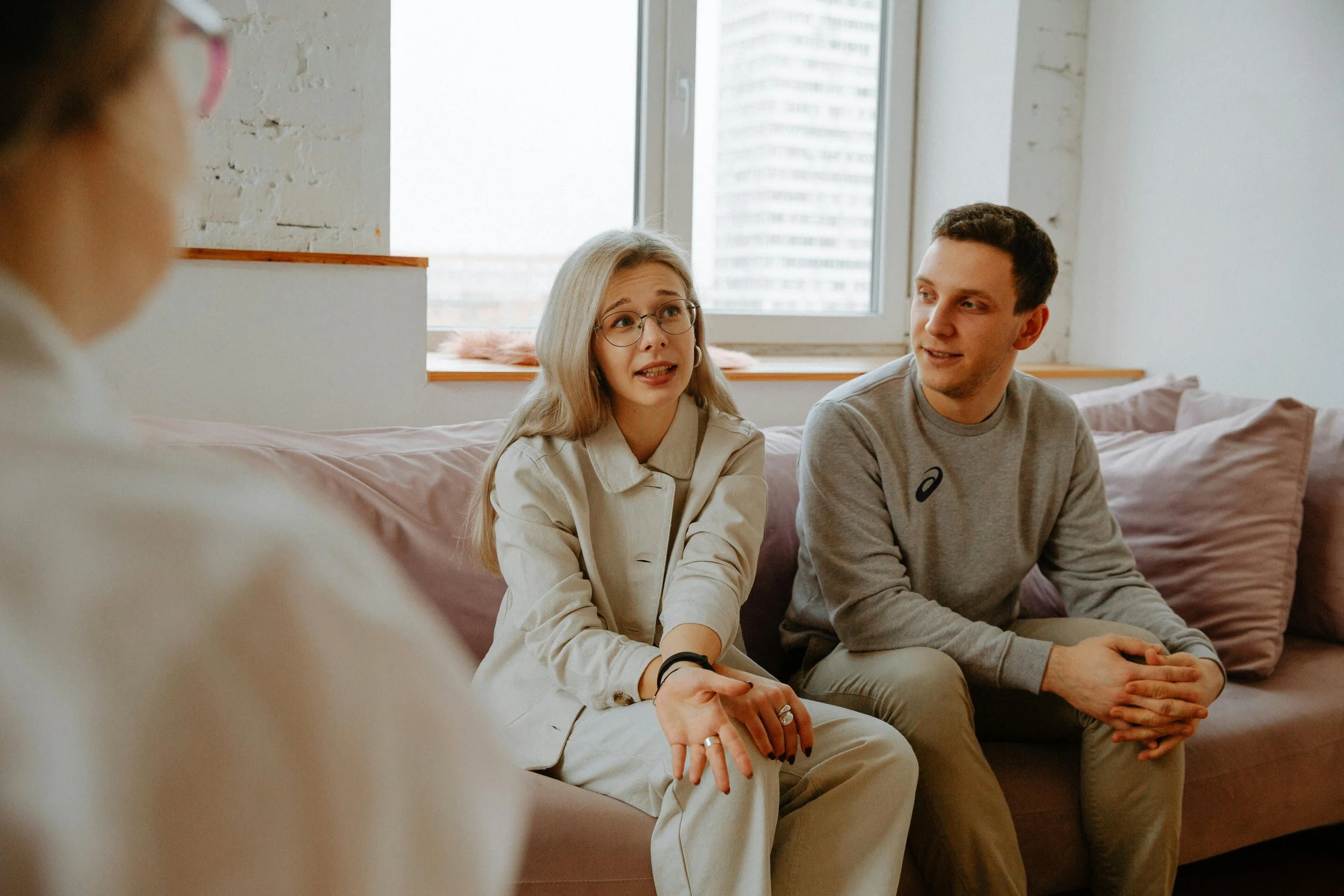
The first session with a couple serves a specific function: it's an assessment and orientation session, not a typical therapy session. Here's what that means in practice:
We start with your story. I'll ask about how you met, how long you've been together, what's brought you in now, and what you're hoping therapy will do for you. Both partners have space to share their perspective.
I'll observe how you interact. Not to judge, but to get a real-time sense of your communication patterns: how you handle disagreement in the room, how you repair, whether one partner tends to pursue while the other withdraws.
We discuss goals and fit. By the end of the first session, we'll have a preliminary sense of what we're working toward and whether couples therapy with me feels like the right match for both of you.
You don't need to prepare a speech. Come as you are. Bring whatever is most present for you. The first session is a starting point, not a test.
Sessions are 50 minutes. Most couples benefit from weekly sessions in the early phase of therapy, transitioning to bi-weekly as progress develops.
Is Couples Therapy Right for You?
Couples therapy works best when both partners are willing to show up, engage honestly, and take some responsibility for the relationship dynamic, not just wait for the other person to change. Perfect readiness isn't required. Ambivalence is normal, and it can be worked with directly in therapy.
Couples therapy may be worth considering if:
- You've had the same conversation multiple times without resolution
- You feel more anxious or guarded at home than you do at work or with friends
- Physical or emotional intimacy has declined noticeably
- One or both partners is considering separation but wants to explore whether the relationship can work
- A specific event (infidelity, loss, a major life change) has disrupted your relationship baseline
Couples therapy is typically not the right format when there is ongoing domestic violence or active coercive control in the relationship. In those situations, individual safety planning should come first. Please reach out to the National Domestic Violence Hotline (1-800-799-7233) if this applies to your situation.
Schedule a Consultation
Frequently Asked Questions About Couples Therapy in Petaluma
Couples therapy helps with communication problems, recurring conflict, emotional disconnection, trust repair, intimacy concerns, life transitions, and premarital preparation. It's appropriate for any couple wanting to improve their relationship, not only couples in crisis.
There's no universal answer. Some couples work on a focused issue and feel resolution in 8 – 12 sessions. Others are working on deeper patterns and benefit from longer-term engagement over 6 – 18 months. We'll discuss realistic timelines based on your specific goals in the early sessions.
Research consistently supports the effectiveness of structured couples therapy. The Gottman Method and Emotionally Focused Therapy (EFT) have substantial evidence bases. Effectiveness is higher when both partners are engaged and willing to apply what's learned between sessions.
Ideally before the patterns become entrenched, but couples can benefit at any stage. Research suggests couples wait an average of six years after problems begin before seeking therapy. Earlier is better, but it's never too late to work on a relationship.
I am in-network with Aetna and United Healthcare/Optum for couples therapy sessions. For all other insurance plans, I am an out-of-network provider, and I encourage clients to check their PPO benefits, as partial reimbursement may be available. Current fee information is available on the Fees & Insurance page.
Yes. Premarital counseling follows a similar structure to couples therapy and focuses on establishing communication tools, surfacing potential areas of conflict before they become problems, and clarifying shared values and expectations.
In most cases, yes. Couples therapy is most effective as a joint process. Occasional individual sessions may be incorporated for specific purposes, but the primary work is done together.
The terms are often used interchangeably. "Marriage counseling" sometimes implies a shorter-term, problem-focused intervention, while "couples therapy" may imply deeper relational work. In practice, I work with both committed partners and married couples, and the approach is tailored to what you need, not to a label.
Yes. Telehealth sessions are available for couples located anywhere in California. Many couples find telehealth convenient, and the quality of the work translates well to the video format.
Whatever is most present for you. There's no wrong answer. You might share what brought you in, what you're most worried about, or what you're hoping therapy will change. I'll guide the conversation. You don't need to have an agenda prepared.

Our past shapes us, and it keeps showing up in ways we do not always expect. I am Elizabeth Harding, LMFT, a Licensed Marriage and Family Therapist in Petaluma, California. I help individuals ages 13 and older and couples work through anxiety, depression, trauma, shame, low self-esteem, and relationship issues. My work is informed by Attachment Theory, Internal Family Systems, and the Gottman Method. I see clients in person in downtown Petaluma and through telehealth throughout California. Reach out for a free consultation.